
Spanish for virtual assistants · Phrase guide
Spanish phrases for work with clients: emails, scheduling and calls
By Soltura · Published · Reviewed
For work with Spanish-speaking clients, a small set of phrases covers most of the day: Estimado or Estimada plus the name and a colon to open an email, Le escribo para… to state why you are writing, ¿Le parece bien el viernes a las 15:00, hora de Ciudad de México? to propose a time, and Quedo atento a sus comentarios to close. Use usted until the client switches to tú, name the time zone every time, and confirm in writing after each call. Below are the phrases by task with English meanings, three sample emails and habits for calls, written in neutral Latin American Spanish.
Part of Spanish for virtual assistants from Soltura.
Who this guide is for
Virtual assistants and remote staff who already work in English and now have a client, manager or vendor who writes in Spanish, and learners who are fluent enough to chat but slow to write work messages. The most common complaint from learners in this spot is that a two-line email takes twenty minutes because every phrase gets checked in a translator. The fix is a small set of reusable lines for each task, which is how this page is organized.
Should you use tú or usted with a client?
Start with usted. The RAE describes it as the form of address used for formal treatment, in Latin America and in Spain [1]. Many clients will move to tú quickly, especially in Mexico and in tech or small-business work. When they do, follow them: Le escribo becomes Te escribo, and ¿Le parece bien? becomes ¿Te parece bien?. Do not move to tú first, and do not mix the two in one message.
Spanish email phrases for work
A Spanish work email has three parts: a greeting with a colon on its own line, a short body that starts with a capital letter, and a closing line plus sign-off [2].
| Spanish | English | Notes |
|---|---|---|
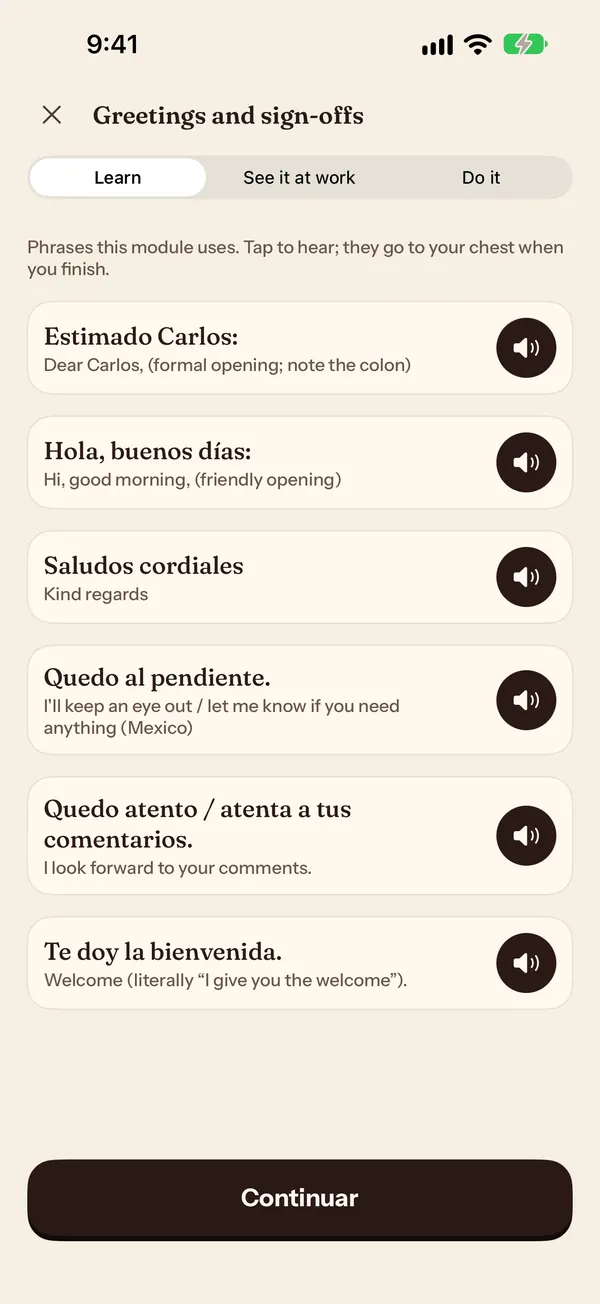
| Estimado Carlos: | Dear Carlos, | Formal opening; colon, not a comma [2]. Estimada for a woman |
| Hola, buenos días: | Hi, good morning, | Friendlier opening for a client you already know |
| Le escribo para confirmar… | I’m writing to confirm… | State the purpose in the first line. Te escribo with tú |
| Le comparto el informe de la semana. | I’m sharing this week’s report. | Common in Latin America for sending a file |
| Adjunto la propuesta. | Please find the proposal attached. | |
| Quedo atento a sus comentarios. | I look forward to your comments. | Atenta if you are a woman |
| Quedo al pendiente. | Let me know if you need anything. | Common in Mexico |
| Saludos cordiales, | Kind regards, | Safe everywhere. Un saludo is common in Spain |
How do you ask a client to clarify a task?
Restate the task in one line before you start. It catches most misunderstandings and shows the client you read carefully.
| Spanish | English | Notes |
|---|---|---|
| Para asegurarme de que entendí bien: … | Just to make sure I understood: … | Then restate the task in one line |
| ¿Me podría confirmar la fecha de entrega? | Could you confirm the due date? | |
| ¿Para cuándo lo necesita? | When do you need it by? | |
| ¿Prefiere que lo envíe yo o que lo revise usted primero? | Would you like me to send it, or would you rather review it first? | Ask before sending anything in the client’s name |
| ¿Me comparte el acceso a la carpeta? | Could you share access to the folder? | |
| No encuentro el archivo. ¿Me lo podría reenviar? | I can’t find the file. Could you resend it? |
How do you schedule a meeting in Spanish?
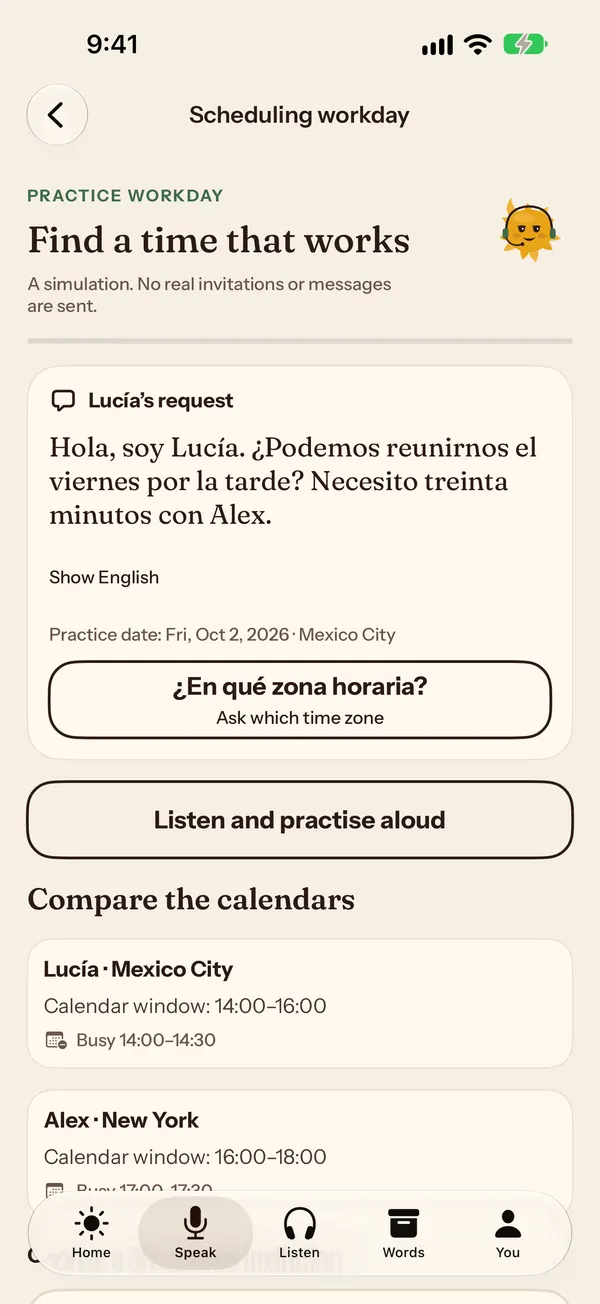
Ask which time zone the client means, offer a specific slot, give both local times if two cities are involved, then confirm in writing. Spanish writes the day before the month (el 15 de octubre), and written messages often use the 24-hour clock.
| Spanish | English | Notes |
|---|---|---|
| ¿En qué zona horaria? | In which time zone? | Ask before you book anything |
| ¿Le parece bien el viernes a las 15:00, hora de Ciudad de México? | Does Friday at 3:00 p.m. Mexico City time work for you? | Written Spanish often uses the 24-hour clock |
| Serían las 17:00 en Nueva York. | That would be 5:00 p.m. in New York. | Give both times when two zones are involved |
| Le confirmo la reunión del jueves 15 a las 10:00, hora del este. | I’m confirming the meeting on Thursday the 15th at 10:00 a.m. Eastern time. | Day before month: el 15 de octubre |
| Le envío la invitación con el enlace. | I’m sending you the invite with the link. | |
| ¿Podemos mover la reunión al lunes? | Can we move the meeting to Monday? | |
| Necesito reprogramar nuestra llamada. Disculpe el cambio. | I need to reschedule our call. Sorry for the change. | |
| ¿Cuánto tiempo necesita? ¿Treinta minutos? | How much time do you need? Thirty minutes? |
Status updates and end-of-day reports in Spanish
A short daily update in the client’s language builds trust fast. Keep it to what is done, what is pending and what comes next.
| Spanish | English | Notes |
|---|---|---|
| Le comparto el avance de hoy: | Here’s today’s progress: | Follow with a short list |
| Ya quedó listo el informe. | The report is done. | Quedó listo is very common in Latin America |
| Queda pendiente la respuesta del proveedor. | We’re still waiting on the supplier’s reply. | |
| Tuve un problema con el acceso. Propongo… | I had a problem with access. I suggest… | Name the problem and a next step together |
| Mañana me enfoco en las facturas. | Tomorrow I’ll focus on the invoices. |
Invoice and payment follow-ups
Name the invoice number and the due date, and end with a question the client can answer with yes or no.
| Spanish | English | Notes |
|---|---|---|
| Le envío la factura correspondiente a septiembre. | I’m sending the invoice for September. | |
| Le escribo para dar seguimiento a la factura 1043. | I’m writing to follow up on invoice 1043. | Dar seguimiento: to follow up |
| La fecha de vencimiento fue el 30 de septiembre. | The due date was September 30. | |
| ¿Me podría confirmar si ya se programó el pago? | Could you confirm whether the payment has been scheduled? | A yes-or-no question is easier to answer |
| Gracias, ya recibimos el pago. | Thank you, we’ve received the payment. |
Phrases for calls and video calls with a client
Calls are where most learners freeze. Four habits help: check the audio first, ask for repetition early instead of guessing, read numbers and names back, and recap before hanging up.
| Spanish | English | Notes |
|---|---|---|
| ¿Me escucha bien? | Can you hear me well? | Use at the start of every video call |
| Perdón, ¿me lo puede repetir, por favor? | Sorry, could you repeat that, please? | |
| ¿Me lo puede decir un poco más despacio? | Could you say it a little more slowly? | |
| Se cortó la llamada. ¿Me repite la última parte? | The call dropped. Could you repeat the last part? | |
| Entonces, quedamos en que… | So, we agreed that… | Recap before you hang up |
| Le mando un resumen por correo. | I’ll send you a summary by email. |
After every call, send a two-line written recap that starts with Como quedamos en la llamada… (“As we agreed on the call…”). It protects you and the client if anything was misheard.
Three sample work emails in Spanish
Change the names, dates and numbers; keep the structure.
| Spanish | English |
|---|---|
| Estimada Lucía: Le escribo para coordinar la reunión con Alex. ¿Le parece bien el viernes 9 a las 15:00, hora de Ciudad de México? Serían las 17:00 en Nueva York. Si le funciona, le envío la invitación con el enlace. Quedo atenta a sus comentarios. Saludos cordiales, Ana | Dear Lucía, I’m writing to arrange the meeting with Alex. Does Friday the 9th at 3:00 p.m. Mexico City time work for you? That would be 5:00 p.m. in New York. If it works, I’ll send you the invite with the link. I look forward to your comments. Kind regards, Ana |
| Spanish | English |
|---|---|
| Hola, Carlos: Le comparto el avance de hoy: – Ya quedaron confirmadas las tres citas del lunes. – Envié los recordatorios de pago de septiembre. – Queda pendiente la respuesta del proveedor sobre el envío. Mañana me enfoco en el informe mensual. Saludos, Ana | Hi Carlos, Here’s today’s progress: – Monday’s three appointments are confirmed. – I sent the September payment reminders. – We’re still waiting on the supplier’s reply about the shipment. Tomorrow I’ll focus on the monthly report. Best, Ana |
| Spanish | English |
|---|---|
| Estimado señor Ruiz: Le escribo para dar seguimiento a la factura 1043, con fecha de vencimiento del 30 de septiembre. ¿Me podría confirmar si ya se programó el pago? Le adjunto la factura de nuevo para su referencia. Quedo al pendiente. Saludos cordiales, Ana Torres | Dear Mr. Ruiz, I’m writing to follow up on invoice 1043, which was due on September 30. Could you confirm whether the payment has been scheduled? I’m attaching the invoice again for your reference. Let me know if you need anything. Kind regards, Ana Torres |
Latin American and Spain Spanish at work
- Agendar una reunión is common in Latin America; programar works everywhere.
- Computadora and celular in Latin America; ordenador and móvil in Spain.
- Quedo al pendiente is typical of Mexico; quedo atento or atenta is understood everywhere.
- Un saludo is a common short sign-off in Spain; Saludos or Saludos cordiales are safe in Latin America.
How to practice these phrases
- Keep a personal file of your best work emails, sorted by task: request, follow-up, scheduling, thanks, problem. Reuse them instead of starting from a blank page.
- Say each scheduling line out loud with real days and times until you can do it without pausing on the numbers.
- Read client voice notes twice: once for the request, once for the details.
- Ask a fluent colleague to check anything legal, financial or sensitive before you send it.
If you are deciding whether your Spanish is ready for client work, try the Spanish-level self-check for VA jobs. Live calls sit close to the CEFR B2 description of regular interaction with native speakers without strain [3].
Where Soltura fits
Soltura is a speaking-first Spanish app with Ruta VA, a course for virtual assistants: 28 modules on inboxes, scheduling, calls and client relationships, plus offline workday simulations where you clarify a Spanish request, act on it and brief your manager in English. Nothing real is sent, and spoken replies are checked on your device. The first scheduling workday is free; the free tier stays free, and Soltura Pro is $4.99 a month, or $39.99 a year with a 3-day free trial (US prices). Soltura does not place VAs or promise jobs.

Free on iPhone and iPad · Mac coming soon
Questions
Frequently asked questions
How do you write a professional email in Spanish?
Open with Estimado or Estimada plus the name and a colon, state the purpose in the first line with Le escribo para, keep each sentence short, and close with Quedo atento or atenta a sus comentarios and Saludos cordiales. Use usted unless the client already writes to you in tú.
Should I use tú or usted with a client?
Start with usted in writing and on the first call. If the client writes or speaks to you in tú, it is fine to switch. Mirror the client rather than moving to tú first.
How do you schedule a meeting in Spanish?
Propose a day and time with the time zone, for example ¿Le parece bien el viernes a las 15:00, hora de Ciudad de México? Then confirm in writing: Le confirmo la reunión del viernes 9 a las 15:00, hora de Ciudad de México. Le envío la invitación.
How do you say time zone in Spanish?
Zona horaria. To ask which one a client means, say ¿En qué zona horaria? and name it in every confirmation, for example hora del este for US Eastern time.
How do you follow up on an unpaid invoice in Spanish politely?
Name the invoice and due date and ask a yes-or-no question: Le escribo para dar seguimiento a la factura 1043, con vencimiento el 30 de septiembre. ¿Me podría confirmar si ya se programó el pago?
How do you ask someone to repeat something on a call in Spanish?
Say Perdón, ¿me lo puede repetir, por favor? or, if the line cut out, Se cortó la llamada, ¿me repite la última parte? Then read the key detail back to confirm it.
What does quedo al pendiente mean?
It is a common Mexican way to end a work message, roughly I’ll stay on the lookout or let me know if you need anything. Quedo atento or atenta a sus comentarios is a neutral alternative.
Sources
Soltura is independent and not affiliated with any organization listed here.
- Real Academia Española and ASALE, Diccionario panhispánico de dudas: “usted”, accessed Oct 7, 2026.
- Real Academia Española and ASALE, Diccionario panhispánico de dudas: “dos puntos”, accessed Oct 7, 2026.
- Council of Europe, Common European Framework of Reference for Languages: Global scale, Table 1 (CEFR 3.3), accessed Oct 7, 2026.