
Spanish for virtual assistants · Jobs guide
Bilingual virtual assistant jobs: roles, requirements and where to find them
By Soltura · Published · Reviewed
Bilingual virtual assistant jobs are remote admin, scheduling, inbox and customer roles where you work in English and Spanish (sometimes another language) for clients in the US, Spain or Latin America. Listings usually ask for fluent spoken Spanish, clear written English, availability in the client’s business hours and a reliable home setup, and most check your Spanish with a live interview or test rather than a certificate. People find them on company career pages, regional job boards, VA marketplaces and hiring groups. This guide covers the roles, what listings ask for, where to look from the Philippines, Latin America, Africa, India and Indonesia, and a Spanish self-check. It does not promise a job or a rate.
Part of Spanish for virtual assistants from Soltura.
What bilingual VA jobs actually involve
The job titles change, but the work falls into a few groups. The Spanish you use depends on the group, so match your strongest skill to the role.
| Role | Typical tasks | Spanish you use most | Voice or non-voice |
|---|---|---|---|
| Executive or admin assistant | Inbox, calendar, travel, documents | Short professional emails, scheduling, summaries for the client | Mostly written, some calls |
| Customer support | Tickets, chat, email, phone | Set phrases for each contact, clarifying, apologizing | Either; voice is more common |
| Appointment setting and scheduling | Booking, confirming and moving appointments | Dates, times, names, numbers, time zones | Mostly voice |
| Real estate or property admin | Tenant messages, showings, maintenance requests | Email, text and WhatsApp messages, calls | Mixed |
| Medical or dental admin | Patient calls, scheduling, intake questions, records | Calls, spelling, confirming details; administrative only | Mostly voice |
| E-commerce support | Order questions, returns, store messages | Chat and email templates | Mostly non-voice |
| Over-the-phone interpreter | Interpreting live calls between two people | Professional fluency in both languages, specialist terms | Voice; a separate profession |
Interpreting is not VA work. One remote interpreting listing for applicants in the Philippines asks for B2+ in both languages, passing a language and interpreting assessment, and at least six months of call center, customer service or interpreting experience [4]. Medical admin roles are administrative too: you schedule and pass messages, you do not give clinical advice.
What job listings ask for
We read public bilingual VA and support listings posted in 2026 on job boards and hiring forums. These requests came up again and again:
- Language: “fluent spoken and written Spanish and English”. Listings aimed at Latin America often ask for native Spanish plus B2 or higher English; listings aimed at Asia ask for strong Spanish on top of English.
- A short intro in the right language. Several ask you to send two or three sentences in English, or in both English and Spanish, with your application. That intro is your first language test.
- Hours. Availability during US business hours, sometimes named as Eastern or Pacific Time.
- Setup. Reliable high-speed internet and a quiet workspace; some ask for your provider and speed.
- Confidentiality. Medical roles mention HIPAA training and confidentiality agreements.
- Channels. Email, phone, chat, text and WhatsApp, plus shared calendars, trackers and CRMs.
Listings rarely ask for a certificate. They ask you to prove your Spanish in the process, so the next two sections matter more than any course badge.
Do you need a Spanish certificate?
Usually not. In VA and BPO forums the common answer is that employers run their own Spanish assessment, often a short interview in Spanish or a written reply to a customer, and that is what you must pass. A certificate still helps when you state a level on a profile or a freelance platform. The DELE diplomas are official qualifications from Instituto Cervantes, run from A1 to C2 and do not expire [2]; SIELE is another Spanish certification [3]. Soltura is not affiliated with Instituto Cervantes or SIELE, and its DELE/SIELE-style practice papers are not official exams and never give an official score.
Spanish-level self-check for VA jobs
Job ads say “fluent” or “conversational” without a level, so test yourself against the tasks instead. Do each one out loud or in writing, with no translator:
- Read a five-line client email in Spanish and summarize it in English in two sentences.
- Write a four-line reply with usted, a greeting with a colon and a correct sign-off.
- Take a three-minute call to move an appointment: confirm the name, the new day, the time and the time zone.
- Spell a name and read back a phone number and an email address (arroba, punto).
- Understand a 30-second voice note at natural speed and note the request.
- Explain a problem and the next step politely, without switching to English.
| Your result | Roles to target now | What to practice next |
|---|---|---|
| All six, comfortably | Voice and mixed roles | Industry terms for your target role |
| 1, 2 and 4, but calls are hard | Email, chat and inbox roles | Listening and short spoken replies every day |
| Two or fewer | Not yet; keep your current role | Everyday Spanish to about B1, then work phrases |
The CEFR descriptions put numbers on this. B1 “can understand the main points of clear standard input on familiar matters regularly encountered in work, school, leisure, etc.”, and B2 “can interact with a degree of fluency and spontaneity that makes regular interaction with native speakers quite possible without strain for either party” [1]. Live customer calls sit closer to B2. For the phrases behind tasks 2 and 3, see Spanish phrases for work with clients and Spanish phrases for customer service.
Where people find bilingual VA jobs
The same handful of channels comes up in every region. Use several at once, and search in both languages: “Spanish bilingual”, “bilingual virtual assistant”, “Spanish-speaking VA”, “non-voice Spanish” and “asistente virtual bilingüe”.
| Where you live | Places people look |
|---|---|
| Philippines | Career pages of BPO companies with Spanish accounts, JobStreet, Indeed, LinkedIn, OnlineJobs.ph, and Spanish bilingual hiring groups on Facebook |
| Latin America | Computrabajo, LinkedIn, Indeed, freelance marketplaces, and US companies hiring remote staff in the region |
| Nigeria, Kenya, South Africa | LinkedIn, Jobberman (Nigeria), BrighterMonday (Kenya), freelance marketplaces and company career pages |
| India | Naukri, LinkedIn, Indeed, and career pages of multilingual support companies |
| Indonesia | JobStreet, Glints, LinkedIn and freelance marketplaces; Spanish openings are fewer, so widen the search to remote roles |
In the Philippines, the IT-BPM industry reported about US$40 billion in revenue and 1.9 million jobs in 2025 (IBPAP, as reported by The Manila Times) [5], which is why Spanish accounts there are a common first step. Watch for scams everywhere: no real employer charges you to apply, sells you a required training course, or interviews only by chat and then asks for payment or bank details.
What “US business hours” means where you live
Most listings want you online while the client is. Here is 9:00 a.m. – 5:00 p.m. US Eastern daylight time (UTC−4), converted. From November to mid-March, when US clocks fall back, each of these shifts one hour later.
| Where you live | UTC offset | Local working hours |
|---|---|---|
| Philippines (Manila) | UTC+8 | 9:00 p.m. – 5:00 a.m. |
| Indonesia (Jakarta) | UTC+7 | 8:00 p.m. – 4:00 a.m. |
| India | UTC+5:30 | 6:30 p.m. – 2:30 a.m. |
| Kenya (Nairobi) | UTC+3 | 4:00 p.m. – 12:00 a.m. |
| South Africa | UTC+2 | 3:00 p.m. – 11:00 p.m. |
| Nigeria (Lagos) | UTC+1 | 2:00 p.m. – 10:00 p.m. |
| Argentina | UTC−3 | 10:00 a.m. – 6:00 p.m. |
| Colombia | UTC−5 | 8:00 a.m. – 4:00 p.m. |
| Mexico (Mexico City) | UTC−6 | 7:00 a.m. – 3:00 p.m. |
Latin America overlaps the US working day; Asia and much of Africa work evenings or nights. Pacific Time clients start three hours later still.
If Spanish is your first language
For VAs in Mexico, Colombia, Argentina and the rest of Latin America, the bilingual part to prove is usually English. Run the same self-check in reverse: summarize a Spanish email in English, write a short English update, and take a mock call in English. Listings aimed at the region often name B2 or higher English, so be ready for an English interview.
How to prepare an application
- Write the two-language intro first. For example: “Hola, soy Ana. Tengo dos años de experiencia como asistente virtual y atiendo correos y llamadas en español e inglés.” (“Hi, I’m Ana. I have two years of experience as a virtual assistant and handle emails and calls in Spanish and English.”) Then the same idea in English.
- Record a one-minute voice sample in Spanish: who you are, what you do, your hours.
- State your level honestly with a CEFR level or plain words, and say which channels you are strongest in.
- Name your hours in the client’s time zone, using the table above.
- Rehearse the interview out loud. Our Spanish interview questions with answer starters cover the usual ones.
What about pay?
Pay depends on the role, the client, the hours and the country, and there is no official published data on VA rates, so this guide does not quote one. Forum posts and single listings are not a reliable average. For published research and set bilingual pay differentials, see do bilingual employees get paid more?
Where Soltura fits
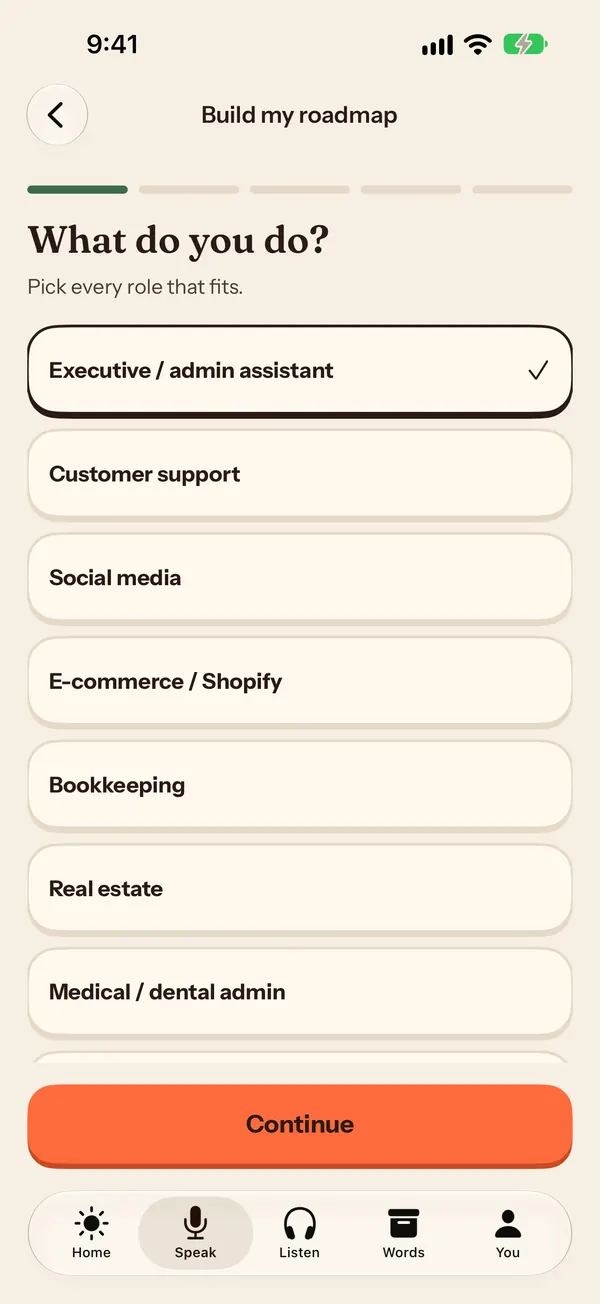
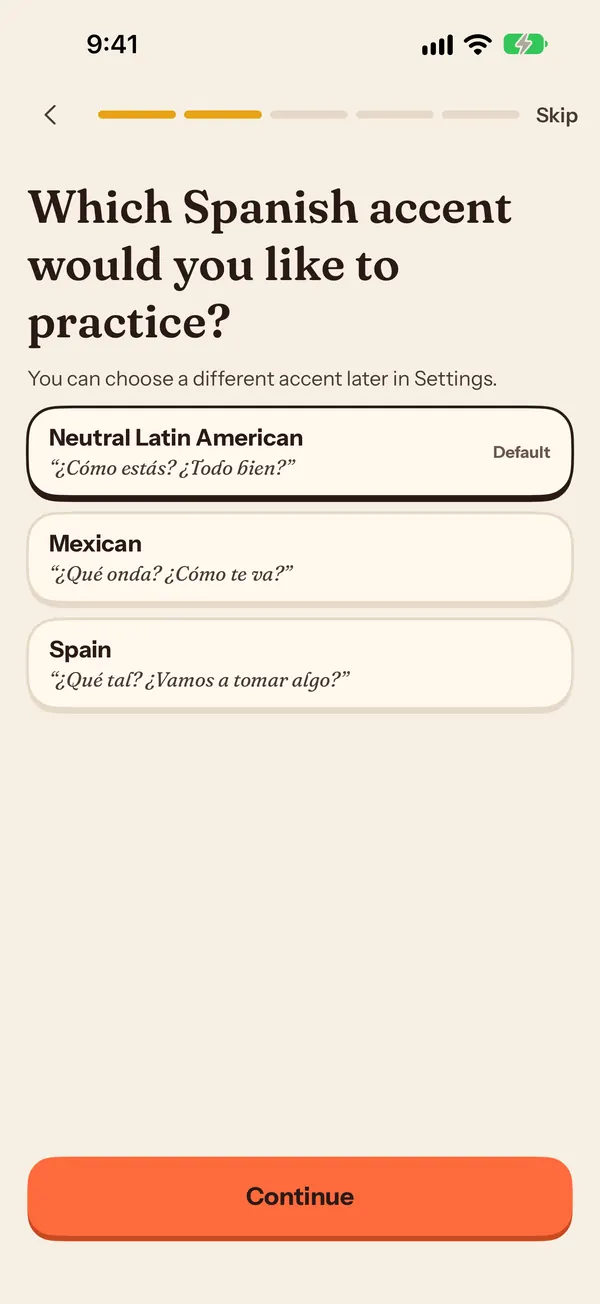
Soltura is a speaking-first Spanish app with Ruta VA, a course for virtual assistants. You pick your VA role, such as executive assistant, customer support, e-commerce, real estate or medical admin, and it builds a roadmap of 28 modules plus offline workday simulations for scheduling, invoices and customer handoffs. Spoken replies are checked on your device. It is practice for the tasks in the self-check above; it does not place VAs, promise jobs or give a certificate. The free tier stays free; Soltura Pro is $4.99 a month, or $39.99 a year with a 3-day free trial (US prices).

Free on iPhone and iPad · Mac coming soon
Questions
Frequently asked questions
What are bilingual virtual assistant jobs?
Remote admin, scheduling, customer support and inbox roles where part of the work happens in a second language, most often Spanish with English. The client is usually in the US, Spain or Latin America and the VA can live anywhere the client accepts.
Can I get a bilingual VA job if Spanish is not my first language?
Yes, many listings test what you can do rather than where you learned it. You need to pass the employer’s Spanish assessment, which for voice roles usually means holding a real conversation. Nothing guarantees a job or a rate.
Do I need a DELE or SIELE certificate to apply?
Usually not. Most employers run their own Spanish interview or written test. A certificate can back up the level you state. The DELE is an official Instituto Cervantes diploma that does not expire. Soltura is not affiliated with Instituto Cervantes or SIELE, and its practice papers are not official exams.
Are there non-voice bilingual VA jobs?
Yes, but fewer. Email, chat, inbox and back-office roles exist, and some support roles take only a few calls. Most Spanish openings still include some calls, so practice speaking even if you apply for written work.
Where can I find bilingual VA jobs in the Philippines, India, Indonesia, Africa or Latin America?
Company career pages, regional job boards, LinkedIn and Indeed, freelance and VA marketplaces, and hiring groups. Search for Spanish bilingual, bilingual virtual assistant and asistente virtual bilingüe. Never pay a fee to apply.
How much do bilingual VA jobs pay?
It varies by role, client, hours and country, and there is no official published data on VA rates, so this guide does not quote a figure. Our bilingual pay article covers published research and pay differentials with sources.
How do I check my Spanish level before applying?
Run the task self-check on this page out loud, then compare yourself with the CEFR B1 and B2 descriptions from the Council of Europe. Live calls with customers sit closer to B2.
Sources
Soltura is independent and not affiliated with any organization listed here.
- Council of Europe, Common European Framework of Reference for Languages: Global scale, Table 1 (CEFR 3.3), accessed Oct 7, 2026.
- Instituto Cervantes, Qué son los DELE, accessed Oct 7, 2026.
- SIELE, Servicio Internacional de Evaluación de la Lengua Española, accessed Oct 7, 2026.
- TransPerfect, Spanish Bilingual Interpreter (Remote, Philippines) job listing, published Feb. 3, 2026, accessed Oct 7, 2026.
- The Manila Times, IT-BMP sector earns $40 billion in 2025 (Dec. 31, 2025), reporting IBPAP figures, accessed Oct 7, 2026.